


teaching
Spotlight: QWriting 2.0
On 13, Oct 2017 | In Spotlight | By Jojo Karlin

Project director: Kevin Ferguson
Project: QWriting 2.0
Project type: Digital Pedagogy, Writing
Discipline: English
Campus: Queens College
Follow: @KevinLFerguson
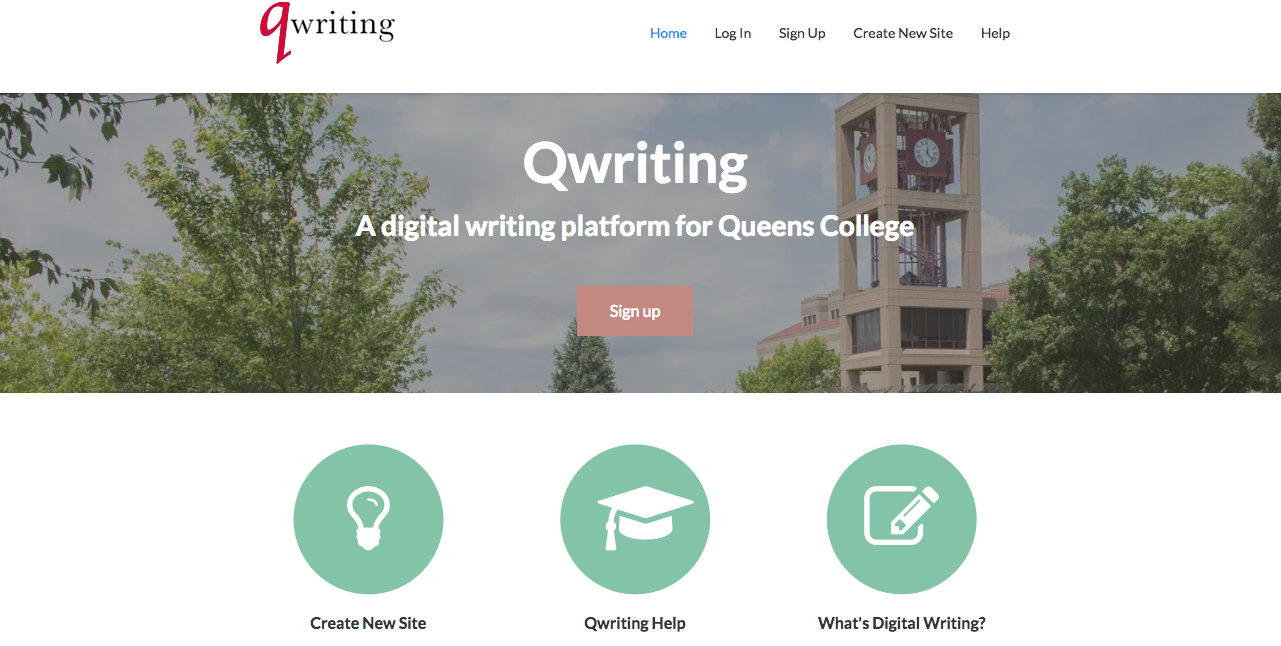
Qwriting, a WordPress installation that serves the Queens College community, has over 19,000 users and hosts thousands of sites, including course blogs, student portfolios, and organizational pages. Qwriting 2.0 is a multiyear initiative to build on the Qwriting platform and the communities that rely on it. Over the past year, the Qwriting 2.0 initiative has included programs to support digital writing pedagogy, technical improvements to the Qwriting platform, increased support for teachers making use of Qwriting in their work, and increased support for student blogging initiatives such as QC Voices.
In spring of 2017, the Qwriting 2.0 team began a workshop series in digital writing pedagogy for instructors at Queens. This series, designed to show teachers in a variety of disciplines how best to deploy Qwriting and WordPress in their classrooms, engaged topics such as QWriting for Digital Assignments and Assessment and Strategies for Online Discussion, Annotation, and Collaborative Work. These sessions provide instructors with both the technical skills needed to use WordPress effectively and the space to consider how digital writing pedagogy can augment their own teaching practices.
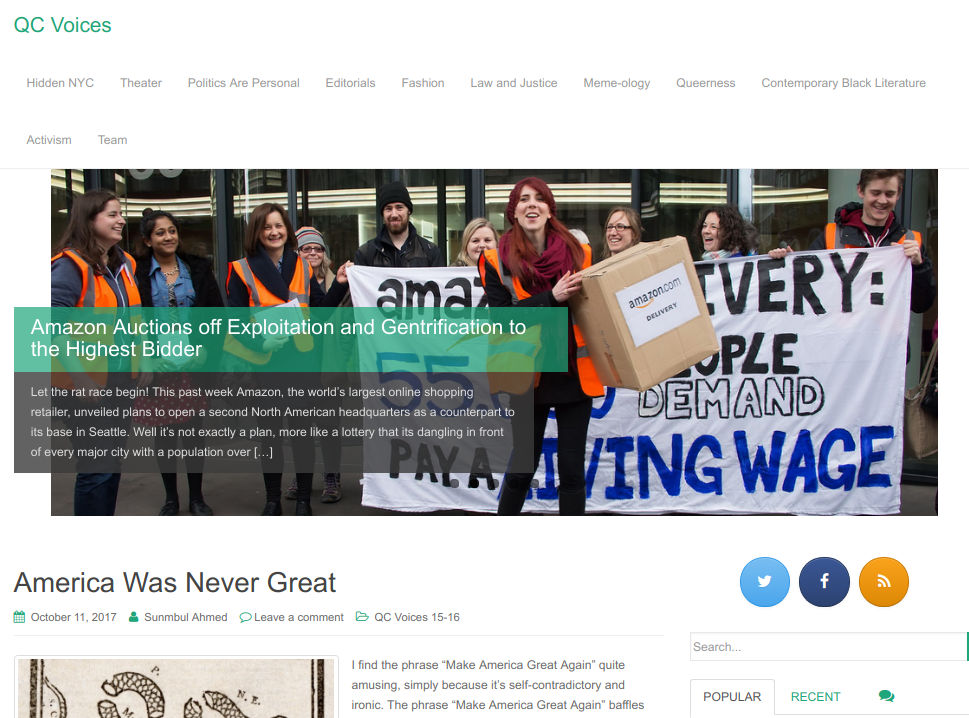
To provide the Queens College community with a high-impact example of digital writing in practice, Qwriting 2.0 provides support for QC Voices, a flagship site that features student thought on issues such as queerness, social justice, equal representation in literature, and life in New York City. QC Voices highlights not only the diversity in perspective of Queens College students, but also their technical proficiency in both writing and modern digital rhetoric. The Qwriting 2.0 team maintains the site and guides and promotes the work of student bloggers as they create work that is routinely read by hundreds or thousands of visitors, both within and outside the Queens College community.
A critical part of the Qwriting 2.0 initiative is the ongoing evaluation and improvement of the Qwriting platform, including considerations of usability, aesthetics, and performance. In the last year, the Qwriting 2.0 team has made technical improvements to increase the speed of the platform, redesigned the site’s home page and documentation, and rethought the signup and site creation process to better serve common use cases. The team also actively encourages adoption of the platform through consultations, class visits, and office hours.
Spotlight: Art History Teaching Resources
On 05, Oct 2017 | In Spotlight | By Jojo Karlin
Project type: Digital Pedagogy
Campus: Baruch
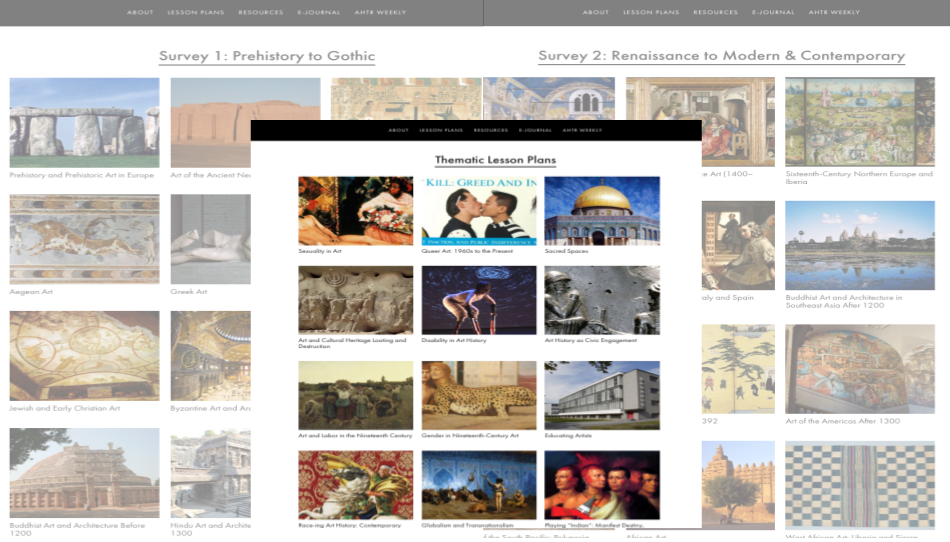
Each academic year, AHTR publishes a series of blog posts on the AHTR Weekly, an increasingly popular feature at ArtHistoryTeachingResources.org. While these short essays primarily target art historians and museum educators, instructors in other disciplines now look to the Weekly for information about innovative pedagogies, open educational resources, and technology-enhanced teaching. Among topics slated for this year are “What’s Your Sutori? Interactive Study Guides and Active Note-Taking,” “Kimono Wednesdays,” “Bomb the Church,” and other effective Reacting to the Past (RTTP) games,” and “3D Printing.”
Some contributors have developed their Weekly posts into peer-reviewed publications for Art History Pedagogy and Practice, AHTR’s academic e-journal on scholarship of teaching and learning. At conferences, AHTR provides faculty opportunities for professional development and collaborative exchange. In October, AHTR will host a session “Pedagogically Sound Approaches for Hybrid and Online Learning,” at the Southeastern College Art Association (SECAC), and for the second year in a row, AHTR organized a round of lightning talks on teaching and learning for the College Art Association (CAA). These presentations, addressing the “State of the Art (History): Re Examining the Exam,” along with proceedings from our SECAC session will be shared and archived through reflection posts on the AHTR Weekly. AHTR is also excited to partner with CAA’s Education Committee this year on a one-day “boot camp” for faculty interested in conducting Scholarship of Teaching and Learning in Art History, and is planning a special issue of Art History Pedagogy and Practice focused on projects developing from this event.
Digital Humanities in the Classroom – Mark Sample and Shannon Mattern [video]
On 19, Nov 2011 | In Video | By Matthew K. Gold
The CUNY Digital Humanities Initiative is pleased to release video from our October 18, 2011 event on Digital Humanities in the Classroom with Mark Sample and Shannon Mattern. Please read our original announcement for more details on their talks. We’re very grateful to them for sharing their work with us!
Mark Sample, “Building and Sharing When You’re Supposed to be Teaching”
Shannon Mattern, “Beyond the Seminar Paper: Setting New Standards for New Forms of Student Work”
Oct 18: DH in the Classroom: Shannon Mattern & Mark Sample
On 13, Oct 2011 | In Meetings | By Charlie Edwards
Please join us on Tuesday October 18, 2011, when we are excited to welcome two innovative practitioners of “Digital Humanities in the Classroom” – The New School’s Shannon Mattern, and Mark Sample, of George Mason University.
Details are below; we look forward to seeing you there!
Time & Place: Tuesday October 18, 2011, 6:30-8:30pm, Room 6496, CUNY Graduate Center
 Shannon Mattern, “Beyond the Seminar Paper: Setting New Standards for New Forms of Student Work”
By exploring how new technologies might function as teaching tools or platforms on which students can demonstrate their learning, we expand the means and ends of education. With this increasing openness of pedagogical forms comes the responsibility to justify our choices and develop new forms of criticism and modes of assessment. Using several of my own courses as examples, I’ll address the challenges and potential benefits of holding students, and ourselves, accountable for the choices we make in our classrooms and advising relationships. I’ll focus on the value of (1) student documentation of their learning process, and in particular (2) students’ justification of their chosen methods and modes of presentation; (3) collaborative development of criteria for evaluation; and (4) connecting our work in the classroom to larger public problems and public institutions.
Suggested readings:
- Shannon Mattern, “Trying to Wrap My Head Around the Digital Humanities, Part 2” Words in Space (June 23, 2010)
- Shannon Mattern, “Evaluating Multimodal Student Work” Words in Space (August 11, 2010)
- Steve Anderson, “Regeneration: Multimedia Genres and Emerging Scholarship” Institute for Multimedia Literacy (June 29, 2008)
 Mark Sample, “Building and Sharing When You’re Supposed to be Teaching”
My pedagogy can increasingly be summed up in five words: “Make things. And share them.” I will talk briefly about my move toward assignments and projects in the undergraduate humanities classroom that emphasize making—as opposed to simply writing. I will also address the sharing aspect of these projects, which I see as a critical intervention into the enclosured experience most students have in higher education.
Suggested readings:
- “Student Contracts for Digital Projects” by Jeffrey McClurken
- “Integrating a Digital Project Into a Class: Deciding on a Project” by Amy Cavender
- “Using a Graphic Illustrator in Higher Education: Comic Life” by Billie Hara
Shannon Mattern is an Assistant Professor of Media Studies and Film at The New School and was, from 2006 to 2009, director of the Masters in Media Studies program. Her research and teaching focus on relationships among media, architectural, and urban space. Her book, The New Downtown Library, was supported by the Graham and Mellon foundations and published by the University of Minnesota Press in 2007. She has also published in several edited volumes and in journals including Space and Culture, Public Culture, and the Journal of Architectural Education. Her classes, which regularly involve the use of digital media, have resulted in the creation of exhibitions and installations and, in Fall 2010, thanks to the support of an Innovations in Education grant from The New School, a prototype of an open-source mapping tool for scholarly urban research. She is a recipient of The New School’s 2011 Distinguished University Teaching Award.
Mark Sample is an Assistant Professor in the Department of English at George Mason University, where is he also an affiliated faculty member with GMU’s undergraduate Honors College, its Cultural Studies doctoral program, and the Center for History and New Media. His research focuses on contemporary fiction, electronic literature, and videogames. His examination of the representation of torture in videogames was recently published in Game Studies, and he is working on a collaboratively written book about the Commodore 64 home computer. Mark has work in Hacking the Academy, a crowdsourced scholarly book forthcoming in print by the digitalculturebooks imprint of the University of Michigan Press. Mark has recently remixed the entire text of Hacking the Academy as Hacking the Accident. Mark is also an outspoken advocate of open source pedagogy and open source research. In recognition of his commitment to innovation in teaching, he was the recipient of George Mason’s 2010 Teaching Excellence Award. He is a regular contributor to ProfHacker, a feature at the Chronicle for Higher Education that focuses on pedagogy and scholarly productivity, and he also writes for Play the Past, a collaboratively edited scholarly blog that explores the intersection of cultural heritage and games.
This event is co-sponsored by The CUNY Digital Humanities Initiative and the CUNY Digital Studies Group, in partnership with The Center for the Humanities at The Graduate Center, CUNY.
Digital Humanities Syllabi
On 06, Jun 2011 | In Resources | By Matthew K. Gold
Do you teach a digital humanities course? Let us know by leaving a comment on this post. We’ll add it to the DH Syllabi page of the CUNY Digital Humanities Resource Guide, which is published on the wiki of the CUNY Academic Commons. I’ve embedded the DH Syllabi wiki page below.
DH Syllabi
CUNY Digital Humanities Initiative
 Welcome to the blog of the CUNY DHI, an effort to build momentum and community around Digital Humanities practitioners at CUNY. We hope you'll join us at our upcoming events and that you'll follow this blog to hear about the latest news in the field.
If you are a member of CUNY and the Commons, please join our group.
Be sure to check out and add to the CUNY Digital Humanities Resource Guide.
Subscription Options:


CUNY Digital Humanities Initiative
Welcome to the blog of the CUNY DHI, an effort to build momentum and community around Digital Humanities practitioners at CUNY. We hope you'll join us at our upcoming events and that you'll follow this blog to hear about the latest news in the field.
If you are a member of CUNY and the Commons, please join our group.
Be sure to check out and add to the CUNY Digital Humanities Resource Guide.



Recent Comments